
The client's mid-sentence about a React migration, and I haven't caught a word of it in about a minute. Camera on. Mic muted. Nodding at the right intervals like some kind of bobblehead running on autopilot. He stops, waits for my answer, and I've got nothing — the mental equivalent of a browser tab that says "loading" forever. Nobody in the room to nudge me back either, because there is no room, just my own apartment and a client waiting on the other end of a laptop camera.
I've been running my business out of the corner of my living room since I went remote, and for years I told myself a desk wedged between the couch and the TV counted as an office. It doesn't, not really; it's a home office setup that never fully committed to being one, and remote work has a way of exposing exactly that gap fast. Three years into working this way, freelance and solo, and I've heard the same questions about building an actual deep work zone in a living room office often enough that I figured I'd answer them properly instead of one Slack message at a time, especially after burning through more focus tools and routines than I can count.
Quick caveat before any of this: I'm not a doctor, a productivity coach, or someone with a research background in cognition. Everything below is what held up under actual client deadlines and what fell apart within a week — not clinical advice. If you're changing your diet, your supplements, or your routine in a real way, loop in an actual professional first.
What Actually Counts as a Deep Work Zone?
A deep work zone isn't just wherever your laptop happens to be open. It's a space — physical, digital, or both — that your brain has learned to associate with one mode and one mode only: sustained, single-threaded attention on a hard problem. Think of it less like a room and more like an environment variable. When it's set, certain processes run. When it's not, your brain defaults to whatever's easiest, which in a living room is usually the fridge, the mail pile, or whatever's paused on the TV.
The mistake most people make in a living room office is assuming the desk itself is the boundary. It isn't. A real deep work zone needs a start signal and an end signal — something consistent enough that your nervous system learns the difference without you having to think about it.
Draw a Hard Line Around Your Desk
Honestly, you don't need a spare room, which is good, because most of us don't have one. What you need is a consistent cue — something you only do when you're about to work, and never otherwise. For some people that's a specific light. For others it's putting on the same headphones every time, even before the audio starts. The exact cue matters less than the consistency of it; your brain is pattern-matching, not reading your intentions.
Lighting does more of this signaling work than people expect. I didn't take it seriously until I noticed how much of my afternoon eye strain and general fog came down to whatever ambient light happened to be in the room, and switching to desk lighting to reduce eye strain and brain fatigue ended up doubling as a work-mode cue, not just a comfort fix.
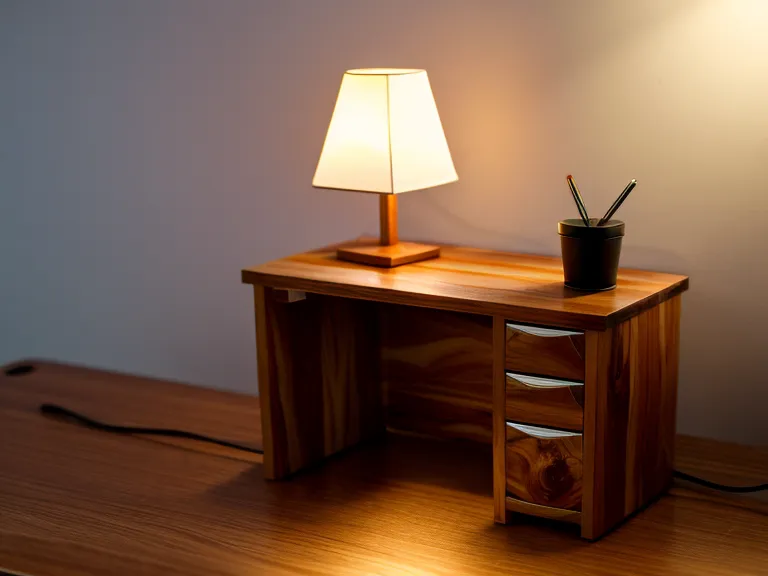
The deeper issue is what happens when your desk pulls double duty as your kitchen table, your bill-paying station, and your work surface. If the same six square feet hosts VS Code and your lunch and your mail, your brain never fully commits — it's forcing a context switch every time, and it pays a tax for that the same way a CPU does swapping processes. There's a term for the cumulative version of this across a freelancer's week — context-switching cost — and it's a bigger drain than any single distraction ever is.
Killing the Notification Noise
Slack is the worst offender here, and I say that as someone who needs it to run a freelance business. Getting pinged every few minutes while trying to hold a complex problem in your head is like having a project manager tap your shoulder mid-thought, over and over, all day. During an actual work block I don't mute Slack. I quit it entirely. Muted still means it's there, waiting, and your brain knows it.
Browser tabs do the same damage in a quieter way. I started keeping work and personal browsing in separate profiles, mostly so a stray notification or a news headline can't sneak into view while I'm reading documentation, and it turned into one of the more effective changes I've made — reducing cognitive load by organizing my browser for coding sounds like a minor tweak until you notice how much mental bandwidth open tabs quietly eat.
Phone goes in another room entirely, not just face down on the desk, because a phone in the room occupies working memory whether it buzzes or not — your brain is subconsciously waiting on it. Midmorning is usually when I notice the tradeoff was worth it: some neighbor's leaf blower cuts straight through a decent pair of noise-canceling headphones, and it barely registers, because there's no phone nearby amplifying the urge to check on literally anything else.
Is a Pre-Work Ritual Necessary?
Yes, honestly, more than the physical setup itself. You can't sit down cold and expect deep focus on command — you need something that boots the system first. Mine has three parts, none of them complicated, and none of it a Pomodoro app with more settings than I'll ever actually touch.
First is a single index card with the one thing that actually matters that day, written by hand. Not Notion, not a project board with fourteen columns. Just ink, because it keeps the actual goal visible even when I'm three layers deep in sub-tasks and half-forgotten tickets. A friend of mine, Devraj Pillai, a former coworker of mine, still finds a new productivity app every couple of weeks and drops it before the trial's even up. I gave up competing with that a long time ago and just went analog.
Second is water and whatever supplement stack I've settled on for the moment — I won't get into which ingredients do what here, that's really its own reference topic, but timing turns out to matter almost as much as the ingredient list itself, which is a separate rabbit hole worth reading if you're curious. What matters for this piece is simpler: hydrate before you sit down, don't treat caffeine as a substitute for it.
Third is headphones, and specifically not music with lyrics, because that's just more data for your brain to parse while it's trying to think. I've found I can genuinely block out home office noise using The Brain Song audio, and it's become the final cue in the sequence — the signal that says the workday actually starts now. There's a broader question about what reliably triggers a flow state versus what just feels productive in the moment, and that deserves its own deep dive rather than a paragraph tacked onto this one.

Negotiating the Living Room Ecosystem
Look, furniture isn't actually the hard part of a living room office. People are. If you share the space with a partner or roommates, you need something closer to a firewall rule than a polite request. My rule is simple: if my work cue is active, treat me as if I've left the building, short of an actual emergency. It sounds harsh written out, but the alternative is renegotiating your attention from scratch every single day, which is its own kind of exhausting.
Eating at the desk was the other habit I had to kill. Now if I'm eating, I'm at the kitchen table, full stop, because a desk that doubles as a lunch spot never fully reads as a workspace to your brain. This isn't about willpower, either — there's a real difference between brain fog and just not trying hard enough, and treating every dip in focus as a discipline failure is how people give up on fixing their actual setup way too early.
None of this is really about Zoom fatigue specifically, which is its own separate remote-work problem with its own fixes — it's about whether the room you're sitting in helps your focus or actively works against it.
Does Any of This Actually Move the Needle?
Not everything I tried worked, which is worth saying plainly. For a stretch I did a cold shower every morning, told myself the shock would reset my nervous system for the day. It was genuinely bracing exactly once, on day one, out of pure novelty, and did absolutely nothing for the two-o'clock crash, which is the crash that actually costs me billable hours. Filed that one under expensive-feeling but free lesson, and moved on.
The clearest sign the rest of it actually worked showed up on an ordinary Monday, reopening a file I hadn't touched since Friday. Normally there's a scramble — what was I even doing here, why did I structure it this way. That morning there wasn't one. The whole decision tree from Friday was still sitting there intact, like the weekend never flushed it out.
Some mornings the ritual just doesn't take. A bad night's sleep, a dead headphone battery, whatever. On those days I've learned not to force a fifth cup of coffee and grind through it jittery. I close the laptop and walk the rose garden blocks over in Ladd's Addition for ten minutes, then come back and start the sequence again. None of this replaces actually tracking your own baseline before you decide a change is working, either — what felt like progress in the moment doesn't always hold up once you look at it plainly.
Building a deep work zone in a shared space isn't a one-time setup, it's ongoing maintenance, the same way a codebase needs upkeep long after the initial build. Some weeks it holds. Some weeks the neighbor's dog wins. Either way, your focus is closer to a production database than most people treat it — worth protecting on purpose, not just hoping it survives whatever else is happening in the apartment.